
Germany eliminating fossil fuels, electrification saves millions and how frozen is frozen?

In this issue:
Fossil fuel to be extinct in Germany within 20 years
Following on from France and the Netherlands, Germany has just published its roadmap to being fossil fuel free. In its case, the target date is 2045. The roadmap integrates climate policy with economic policy. Fossil fuels accounted for 65% of Germany’s energy consumption in 2024, nearly all oil and gas being imported, with some coal produced domestically. Its electricity system is around 55% renewable at the moment.
Electrification saves millions
Electrification has saved the residents of Victoria AU$185 million (NZ$229m) since 2023, according to a new analysis from the IEEFA. It has also avoided the use of 5.6PJ of gas per year. The continuation of the trend, proffered as likely by the authors with new regulations being introduced in 2027, will see 40PJ of gas use avoided each year by 2040 and cumulative savings of AU$6.6 billion (NZ$8.2bn).
Supply chain emissions up
MIT has just published its latest State of Supply Chain Sustainability report, which reveals supply chain emissions have increased for around one in three organisations, mostly on the back of newly introduced tariffs and trade disputes. The result of these shifting economic sands has seen companies having to reroute freight, switch suppliers or switch to more distant source locations. The impact of AI emerges as positive, on balance, through improved supply chain efficiency but this outcome differed quite substantially across businesses with a significant minority reporting poorer outcomes once the AI’s emissions were factored in. The conclusions were drawn from 1,810 responses across 91 countries.
The economics of replacing renewables
A report from Wood Mackenzie into the economics of aging renewables concludes, quite compellingly, that recommissioning aging renewable sites – wind and solar – can be more profitable than new builds. The fact these early facilities will have been built on the best sites, will have existing grid connections, consents already in place and community acceptance, all contribute to their attraction. The anticipated outcome is that the facilities will hold value because of these factors despite aging equipment. The report also suggests equipment replacement will be brought forward from original expectations in many cases to take advantage of improved technology, with a knock on effect of reduced power prices.
Industry standard questioned
New Zealand’s food regulations stipulate frozen foods must be stored at a maximum temperature of -18C, a common, global, industry standard. New (peer reviewed) research from Nomad Foods, Europe’s largest frozen food company, active across 22 countries, has shown most frozen foods can be stored safely, with maintained quality, nutritional value and shelf life at -15C. The significance of this is a 7% reduction in energy consumption when storing at the slightly higher temperature.
40% of world exposed to harmful ozone
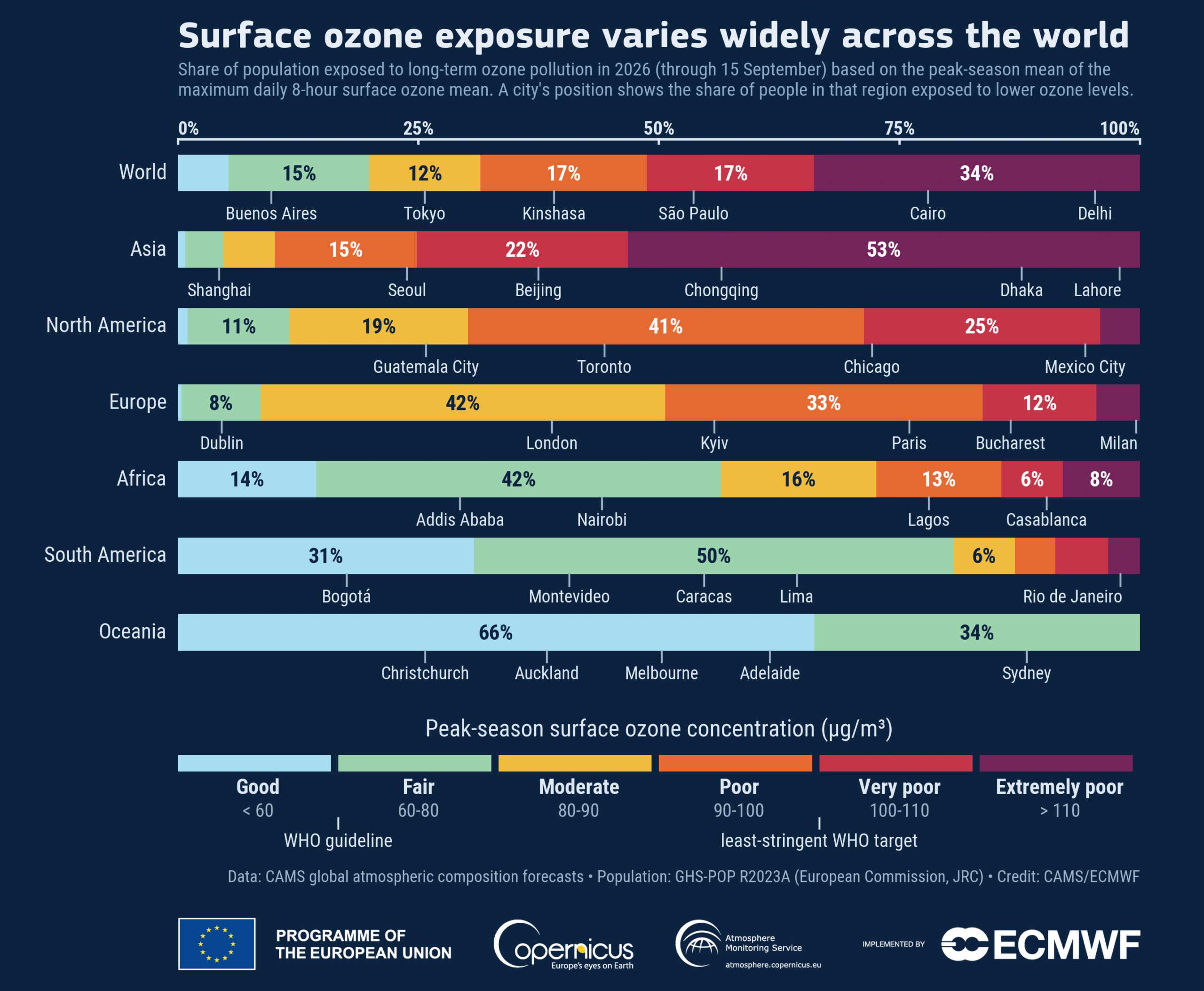
A new report from the EU’s Copernicus Climate Atmosphere Monitoring Service reveals 40% of the world’s population is exposed to harmful ozone pollution caused by heatwaves, wildfires and human-created pollution. Of course, the heatwaves and wildfires are not independent of climate change caused by human-created emissions. Asia is the worst affected area with 53% suffering extreme exposure. Fortunately, New Zealand sits firmly in the OK zone.
Peaks and troughs
Peak Antarctic ice for 2026 occurred on 14th September. It was the third smallest coverage recorded, at 17.59 million square kilometres, in the 48 years of tracking. Meanwhile, the Arctic reached its minimum coverage on 12th September at 4.60 million square kilometres. This is the tenth lowest on record, although maintains the recent trend with the 20 lowest coverage years all being in the last 20 years. The data are collected and analysed by the National Snow and Ice Data Centre (University of Colorado Boulder).
Did you know ……
Exports of clean tech from China in 2025 lead to the avoidance of more emissions for a year than the UK pumps out? China’s clean tech exports for 2025 are estimated to avoid emissions of 374 MtCO2e a year. Over their lifetime, this US$194 billion (NZ$346bn) of solar panels, batteries, wind turbines and EVs will save 6.9 billion tonnes of CO2e emissions.