
AI accuracy, emotions outweigh numbers and the cost of inconsistent battery cells

In this issue:
The results of publicly funding clean energy
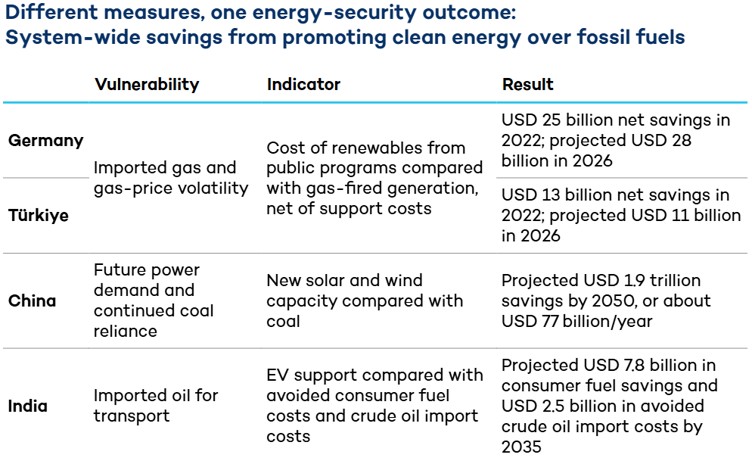
In a study of four major fossil fuel importing countries, analysts from the International Institute for Sustainable Development have concluded public financing of clean energy has dramatically reduced exposure to fossil fuel price volatility. The analysis covers Germany, Türkiye, China and India who, collectively, account for 40% of oil imports and 27% of gas imports and concludes each has cut import bills, stabilised prices, protected consumers and strengthened competitiveness through publicly funded support for clean energy. With the results being consistent across countries of different sizes and wealth, the authors proffer the beneficial outcomes are not isolated and are actually the norm that can be expected from such support.
We’re emotional beings
That’s what’s been established by researchers looking to unlock triggers for climate action. A team from the University of Geneva has concluded messages based on data are far weaker than emotional triggers at provoking climate action. Meanwhile, messages focused on individual responsibility have little impact and can even be counter productive. The meta study used data from 71 separate experimental studies with a combined participation of 216,000 people.
Make America Grubby Again
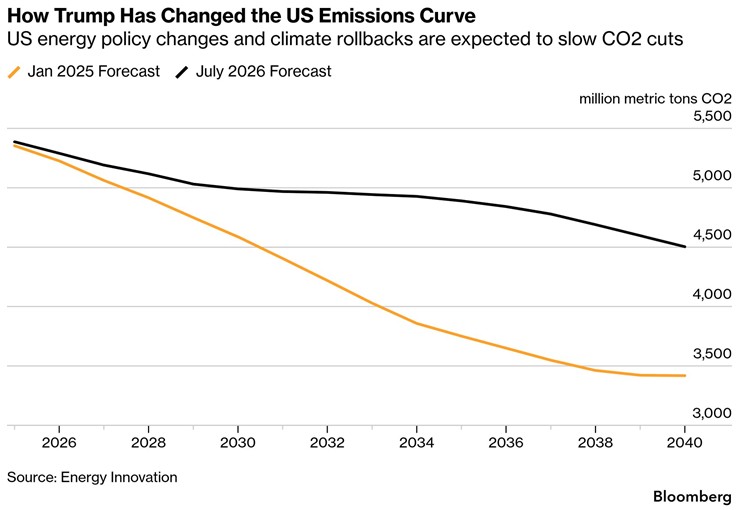
This week saw another backward step on emission from the Trump administration when it repealed fully the Endangerment Finding, a set of measures put in place by the Obama administration in 2009 to curb pollution and emissions from fossil fuels. Regulations covering vehicle emissions were repealed in February but this week saw those covering electricity generation from fossil fuels removed as well. The Environmental Defense Fund claims, by 2055, the repeal will cost the US as much as US$1.4 trillion (NZ$2.4trn) in fuel costs and US$500 billion (NZ$872bn) in health costs, 58,000 premature deaths and 18 billion tonnes of pollution (all figures its high impact scenario). A separate analysis by Bloomberg has produced the following impact chart.
Always Inaccurate
Some will have us believe AI will perform every task currently done by humans in the next few years and there’s no doubt AI use will continue to skyrocket. One area where AI is becoming prevalent is in emissions calculations, particularly in respect of lifecycle emissions. But is it accurate? Not as accurate as you might wish, according to researchers at Watershed, one of the companies offering emissions calculation services to the market using its AI platform. Watershed claims its platform differs because it conducts its analysis step by step, as an auditor would, where others simply assess an overall value from an input data set. The conclusion: The leading AI platforms achieve at best 77% accuracy overall but if they are requested to perform the calculation step by step, that falls to as low as 37%. Let’s hope the plethora of stories we’ve been seeing recently about AI being an existential threat to humanity are equally inaccurate or exaggerated.
Direct air capture showing some signs of progress
After many false starts and disappointments, it seems DAC is showing some signs of improvement. Swiss company Climeworks, which operates the world’s largest direct air capture facility in Iceland is reporting stark performance improvements in the last 12 months. It removed 675 tonnes of CO2 in the first half of the year, six times as much as the same period last year and the cost of running the plant has halved. Notably, the release from Climeworks didn’t provide any more detail on the cost of the capture.
The weakest link
EV battery degradation is not consistent across cells within a pack and it is the weakest cells that determine the overall performance of a battery pack and its useful life. A team of researchers from China and Sweden analysed battery cells from 116 cars and 17 buses using data from 3 years and as much as 300,000Km of operation. It found the fastest aging cells were the ones that dictated the performance and lifespan and that inconsistencies in cells reduced battery state of health by 6.2% in cars and 7.5% in buses. Inconsistent cells reduced lifespan by 17.7% in cars (22.8% buses). For these packs, lifetime energy-resource utilisation reached only 80.7% for cars and 72.9% for buses, crucially, meaning when packs were retired, car packs were wasting 19.3% and buses 27.1% of their potential energy source, respectively. Naturally, the paper concludes with a call for better consistency in the manufacturing process.
Did you know ………
Our brains use 20W of energy and use that amount pretty consistently? Counterintuitively, it seems when we are busy the consumption doesn’t materially increase, some areas of the brain consume more energy but this is compensated by other areas gearing down. Even when we sleep, the consumption is maintained by dreaming. This 20W is around 20% of the body’s total energy use of 100W when resting. Of course, the total use can increase seven fold with physical work but the brain remains at 20W.