
The AI balance, combatting energy hardship and climate whiplash

In this issue:
More harm than good
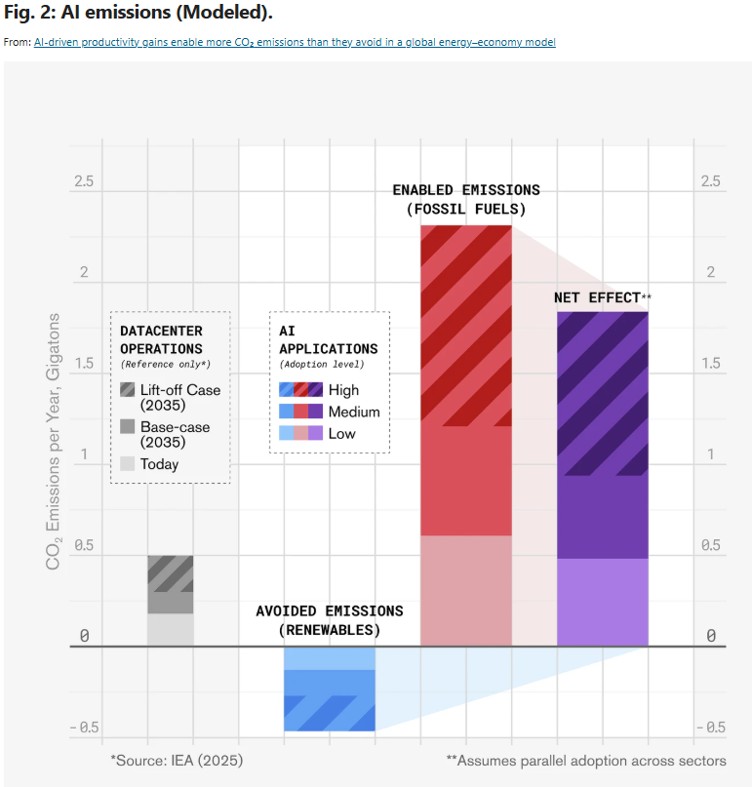
In the ever flip-flopping conclusions on whether AI will deliver net climate benefit or harm, the latest output suggests the harm will likely outweigh the good. A group of US researchers looked at potential productivity gains from AI in the renewables and fossil fuel sectors, concluding productivity gains in renewables would need to be 4 to 5 times greater than in the fossil fuel sector to break even. The difference emerges around the magnitude of production cost reductions – an area not previously considered, with the fossil fuel sector likely to gain substantially stronger productivity benefits from AI adoption.
Effectively combatting energy hardship
New research from the Lawrence Berkeley National Laboratory (US) reinforces that measures to improve weathertightness and efficiency strongly complement financial assistance when it comes to combatting energy hardship. Support in the form of (a) financial assistance, (b) efficiency improvements and weathertightness and (c) rooftop solar, when applied together, improve energy affordability at lower net present cost than financial assistance alone. While New Zealand’s Winter Energy Payment is extremely helpful for many households, we shouldn’t lose sight of other means of addressing energy hardship, especially through reducing demand.
No surprises
No surprises but not much good news either in the 36th State of the Climate report from the American Meteorological Society. The report covers data from 2025 and reveals record highs for (normalised) global average temperatures, greenhouse gas concentrations, global sea levels, glacial loss and ocean temperatures. Soil moisture at its lowest recorded average was also identified as a critical problem, with the trend likely to impact food production significantly in years to come.
NY ♥ TEN
The Mayor of New York and state Governor have announced a new partnership to investigate the feasibility and benefits of a Thermal Energy Network under the city at one of its busiest station complexes (Brooklyn Bridge-City Hall/Chambers Street). The project will be looking at reducing temperatures in the stations and using the heat to warm nearby municipal buildings. The project includes assessing the efficacy of storing heat collected in the summer in boreholes for use in the winter.
Cowboy risks
It pays to be careful when selecting your solar installer. Insurer QBE is reporting occurrences of fires in the UK caused by solar panels increased by 133% in the period 2022-2025, more than double the increase in the number of installations (52%). The increase is being attributed to unqualified or slapdash installers. Other advice from QBE is to undertake regular inspections and cleaning, especially after extreme weather events, avoiding mounting on combustible roofs (really!) and checking the quality of connectors and the siting of supporting batteries.
Solving your own problem
Low temperature waste heat from industrial plants and data centres can be difficult to recover economically. Utilising the heat for things like district heating systems is often proffered as a solution but that assumes reasonably close proximity, which is not always the case for these commercial sites. However, a team of engineers from Korea Institute of Machinery and Materials may have come up with a self-healing solution. They have developed an adsorption heat pump that turns low-temperature waste heat directly into cooling power. Conventional adsorption cooling technology requires heat sources above 70C. This new process can operate with temperatures as low as 40C, opening a large range of additional applications. The system uses natural ammonia as its refrigerant and delivers double the performance of existing adsorption technologies. A 10 kW-class prototype is currently undergoing demonstration testing.
Hydrogen at less than US$1 a kilo
That’s the claim for a new process in delivering green hydrogen developed by scientists from Ohio State University. The economics rely on using low value industrial waste such as steel slag and coal ash to capture the CO2, the process then converting that into high purity calcite, which has applications in construction, agriculture and pharmaceuticals. The process also reduces the amount of energy needed for electrolysis. Between the value of the energy saved and the sale of the calcite, the net cost of the hydrogen comes out at the US$1 per kilo mark, a price compatible with hydrogen manufactured from gas. The developers believe widespread adoption could save 500 million tonnes of emissions a year.
Jargon buster: Climate whiplash
Climate whiplash is the state of rapid transition between opposite weather extremes, such as dry to wet or hot to cold. The impact of the transition is magnified by its pace, giving nature little time to adjust. Some definitions emphasise climate whiplash as being volatility in the climate as measured across months or years, with more immediate (daily or weekly) transitions as weather whiplash.