
UN backs ICJ, swapping saves 2,000 hours and hitting or missing the marque

In this issue:
UN passes resolution on climate liabilities
Last week, the UN General Assembly passed a resolution supporting last year’s ruling from the International Court of Justice that it is unlawful for countries to neglect their climate commitments. In other words, not taking action on climate change may be a violation of obligations to current and future generations under international law. While the resolution is not binding, it does open the door for claims of reparations. 141 countries voted in favour of the resolution, 8 against. Unsurprisingly, the US was at the forefront of those voting against, alongside Belarus, Israel, Liberia, Russia, Saudi Arabia, Yemen and Iran. An interesting set of bedfellows.
Wind and solar surpass gas
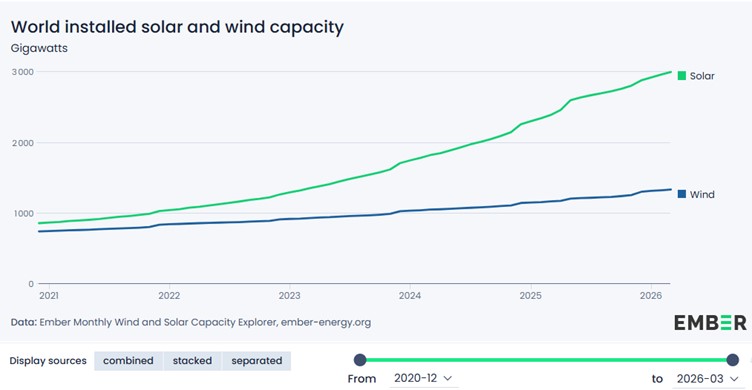
Wind and solar are now generating more electricity around the world than gas, according to the latest release from Ember. Combined, wind and solar generated 22% of global electricity supply in April, the proportion delivered from gas being 20%. The leap may be short-lived as spring weather in the northern hemisphere tends to lift wind and sees solar recovering from winter but the trend towards these renewables is relentless and the switch will inevitably become embedded over the medium term.
87% of investment firms see bright future for renewables
Unsurprising in the current environment but still encouraging is that 87% of UK investment firms expect to see a surge in renewables financing on the back of the oil crisis. A member survey by the UK Sustainable Investment and Finance Association also found 78% thought renewables projects were now less risky and 65% saw greater benefit in a rapid transition.
$182 billion (US$107bn)
That’s how much carbon pricing mechanisms generated in 2025 according to the World Bank Group. Emission trading schemes or carbon taxes now cover 29% of global emissions. Hopefully, the revenue is being used constructively to reduce emissions.
SBTi pivots
In a significant step in its evolution, the Science Based Targets Initiative has announced a change in emphasis of its service. Up until now, its focus has been on target setting and verification. It is now shifting to look more strongly at helping clients achieve those targets.
Battery swapping saves 2,000 hours of downtime
Battery swapping has been mooted for some time as a mechanism to speed up the adoption of electric vehicles as it dramatically cuts downtime, especially crucial for commercial haulage. Battery firm CATL has now launched a swapping ecosystem for light trucks in China. The target is for a network of 30,000 swap stations, with 3,000 to be built this year. The stations will cater for passenger vehicles as well as light trucks. With a swap time of 2 minutes, it is quicker than refilling a diesel tank and is claimed to save 2,000 hours of refuelling time over an 8 year lifespan of a truck.
Michelin drops sustainability rating
New Zealand has no Michelin starred restaurants and will never have a Green starred restaurant. The tyre manufacturer come restaurant guide publisher has not previously extended its reach to New Zealand but when that changes at the end of June it will be too late for restaurants to be judged on their sustainability performance, as the guide is dropping its green star rating system.
Missing the marque?
With the help of Pope Leo XIV, Ferrari has launched its first fully electric car. The Luce is also Ferrari’s first 5-seater and this, along with its less than traditional looks, has seen a tsunami of criticism for the famous and usually revered Italian car maker. Despite being more than 6 times the price of a Tesla Model S Plaid, it is slower and has a shorter range. At launch, Ferrari shares fell 8% on the Milan stock exchange.
Did you know …..
Solar panels produce 12% more power when offshore? That’s the conclusion of a study by scientists from the National Taipei University of Technology. The differential is caused by the cooling effect of the sea, apparently.