
Ireland’s intermittency solution, 1.37 and counting and give us the power

In this issue:
We are not alone ...
… in missing emissions reduction targets. A new report from World Resources Institute reveals the world’s largest economies are falling woefully short. G20 countries account for 75% of global emissions. WRI analysed emissions trends of 14 of the G20, finding 9 of the 14 are not trending positively towards their stated 2030 targets. Australia, Indonesia, Russia, South Africa and Turkey emerge from the analysis as being in reasonable shape to hit targets, the others are falling substantially behind. Looks like there’ll be a serious lolly scramble for credits in just a few years.
CDP splits
CDP, formerly the Carbon Disclosure Project, has announced it is to undergo a major restructuring. Since inception in 2000, the not for profit CDP has been at the forefront of emissions disclosures and has grown to covering around 25,000 entities. The split will see the CDP Foundation continue as a not for profit entity furthering corporate disclosures, while CDP will become a profit-based provider of data and disclosure services. CDP is backed by private equity firm, Permira.
1.37
Is the latest estimate on how much above pre-industrial levels the world is sitting, according to the IGCC (Indicators of Global Climate Change) report. The report concludes we will likely be hitting the 1.5C increase threshold as early as 2030.
Give us the power
Is the message coming from businesses worldwide as companies plan to electrify en masse. A recent study by the We Mean Business Coalition (and others) across 18 countries indicates 73% of companies expect to be largely electrified by 2030 and 90% by 2035. 88% of companies indicated they see electrification as improving their competitiveness, with the same proportion saying it will help their business grow. 84% anticipate lower operating costs, 80% expect lower energy bills and 80% expect electrification to create jobs. 40% have already invested in on site generation with another 47% actively considering it.
Net Zero Standard opens for consultation
After two years of development, the International Organisation for Standardisation has just released its Net Zero Aligned Organisations Standard, ISO14060, for consultation. The Standard is aimed at helping organisations convert net-zero targets into actionable and auditable plans. The consultation will be open for 12 weeks.
Fortune favours
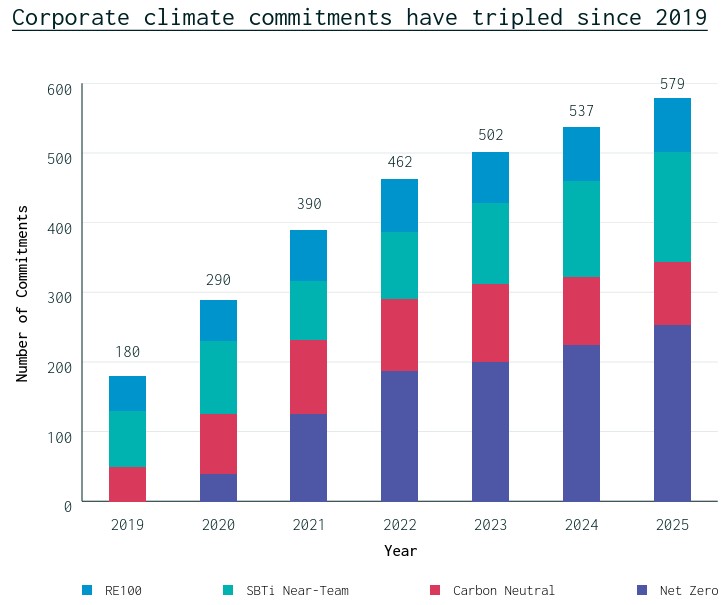
Companies captured in the Fortune Global 500 list, effectively the 500 largest companies in the world, who collectively account for a third of global GDP, have tripled their climate commitments since 2019 according to a new report from Climate Impact Partners. 51% of the companies have net zero targets and the number of companies with at least one climate commitment has increased from 24% in 2019 to 72% in 2025. 44% of companies expect to be using carbon credits as part of the climate strategies.
Ireland’s intermittency solution
Irish company Net Zero Energy is proposing to build a 600MW long-duration storage facility at Rathoe, Co. Carlow. Based on underground hydrogen storage, the €2 billion (NZ$4bn) project will occupy a 50 acre site and be capable of providing 10% of Ireland’s peak electricity needs. The facility is expected to save around 180,000 tonnes of CO2 emissions a year, equivalent to taking around 40,000 cars off the road, and make a correspondingly beneficial reduction in 2030 liabilities. Of course for that much, they could have built a couple of LNG terminals.
Smart homes joint offering
The future of domestic smart energy integration is now available in Europe with BMW and Solarwatt offering a packaged system that combines solar generation, storage, two-way vehicle storage and the smart management system to get the best from it all.

Did you know ….
While New Zealand struggles to come up with a coherent energy strategy, the UK has recently published an Active Travel Strategy for the whole of England and is putting £4.5 billion (NZ$10bn) behind it. The strategy has very specific 5 and 10 year targets and is aimed at getting people healthier just as much as reducing emissions. Of course, New Zealand does have localised strategies but nothing on a national scale or funded to this degree.