
Energy policy can boost GDP, EV longevity and a new iron age

In this issue:
Could business energy policy boost GDP by $8bn?
A new report from the UK’s Confederation of British Industry and Energy UK claims the UK economy could be boosted by £130bn (NZ$300bn) through changes to energy policy. A back of envelope proportioning exercise using relative GDP suggests the equivalent GDP boost in NZ could be NZ$8bn. While some of the policy recommendations are UK specific, many are not, including:
- Reforming business energy taxes
- Raising non-domestic minimum energy standards
- Targeted operational expenditure discounts to incentivise electrification
- Create a publicly financed Energy Transition Funding Scheme
What are we waiting for?
Newer EVs stand the test of time – but look after them
Analysis of the state of EV batteries from a sample of nearly 23,000 vehicles suggests fear of degradation should not be a serious deterrent to purchasing a second hand EV. However, it also shows newer vehicles to be performing better and care should be taken in charging. An earlier study (2020) showed annual degradation of battery performance to average 2.3%. A 2023 update showed average degradation had reduced to 1.8% p.a., thought to be attributable to better chemistry, thermal management and software in newer vehicles. However, the 2025 update showed degradation had crept back up to 2.3% p.a., put down to the increasing use of fast chargers with regularly fast charged vehicles suffering double the degradation rate of non-fast charge users. Nevertheless, buyers can reasonably expect 15-20 years from their vehicles from new.
The risks of offshore CO2 storage
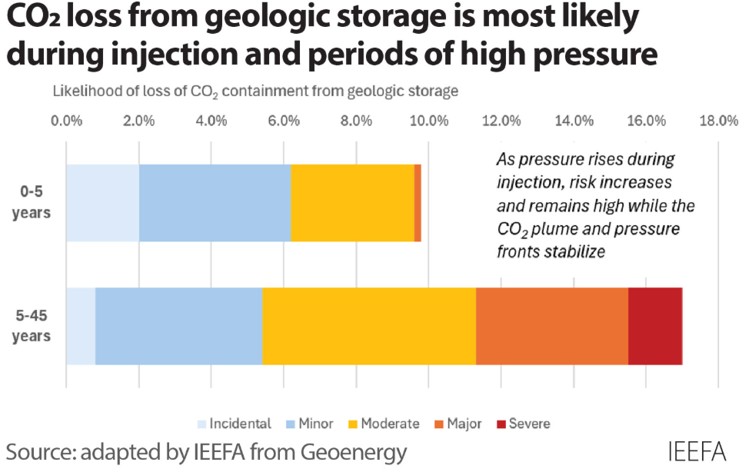
Despite repeated failures, carbon capture and storage remains on the corporate agenda of many – mainly fossil fuel – companies. Recently, there has been a significant uptick in lease purchases of potential offshore sites in the Gulf of Mexico, where it is proving easier to deal with state and federal landowners than private landowners and community groups onshore. However, analysis by the IEEFA suggests the risks of offshore CO2 storage are being seriously underestimated, or ignored, as its proponents attempt to promote the technology. The analysis indicates understated risks around:
- Operational challenges, especially around the injection process, with leaks more difficult to detect when offshore
- Loose regulatory frameworks
- The lack of long term data on efficacy
Biggest RTC storage facility announced
BYD and Masdar have announced an 11.275 GWh storage project in Abu Dhabi, claiming it the world’s first RTC (Round The Clock), gigascale, integrated solar and battery storage facility. The facility will see 5.2GW of PV married with 19GWh of battery energy storage. The capacity is equivalent to 186,000 EV packs.
NZ storage lagging
While we repeatedly see stories (often in this organ) about investment and growth in large scale energy storage, New Zealand lags the global storage boom, reports DLA Piper. Of course, other regions, especially Europe, have the influences of negative power prices and/or capacity markets contributing to the drive and NZ has neither of these, which may partly explain the lag. However, it does mean we are missing out on the benefits of commercial scale storage and its contribution to bolstering renewables.
Three degrees
Not the latest estimate of warming, or King Charles’s favourite female vocal group but the level of temperature increase for frozen food transportation being called for, to save 18 million tonnes of CO2e each year. The industry standard for transportation of frozen foods is -18C, whereas anything below -12C is sufficient to eliminate microbial activity. There is now a growing call for the standard to be lifted to -15C, saving a huge amount of energy (25TWh), around 7% of supply chain costs and those 18 million tonnes of emissions, without compromising food safety, although compromising the margin of error.
A new iron age
Scientists at the Karlsruhe Institute of Technology have developed a technique for storing and transporting renewable energy using iron powder. The process burns iron powder to release energy and make rust and renewable energy to convert the created rust back into iron. The whole process is claimed to be emissions free. Iron powder behaves like coal when burnt and can generate high temperatures for industrial processes or electricity generation. It is stable, easily transportable and requires only modification to coal fired plant, rather than completely new kit.
Did you know …..
Volvo is now making electric trucks in Australia? While the Swedish truck manufacturer has been building trucks in Australia since the 1970s, July 2026 has seen the first electric heavy vehicle roll off the production line, making Volvo the first mainstream heavy electric truck manufacturer in Australia.