NZ has best performing ports, calculating sports travel emissions and free cooling

In this issue:
Only a matter of time
It was only really a matter of time, but many scientists have been declaring the 1.5C target temporarily defunct this week following the latest publication from the UNEP. Released on Wednesday, the Limiting Overshoot Spotlight Report acknowledges we will be exceeding the 1.5C target. The report predicts a best case of 1.8C warming but also suggests the temperature increase can peak at this level and subsequently decline back below the original 1.5C ……… if we act swiftly.
NZ best in the region for in port shipping emissions
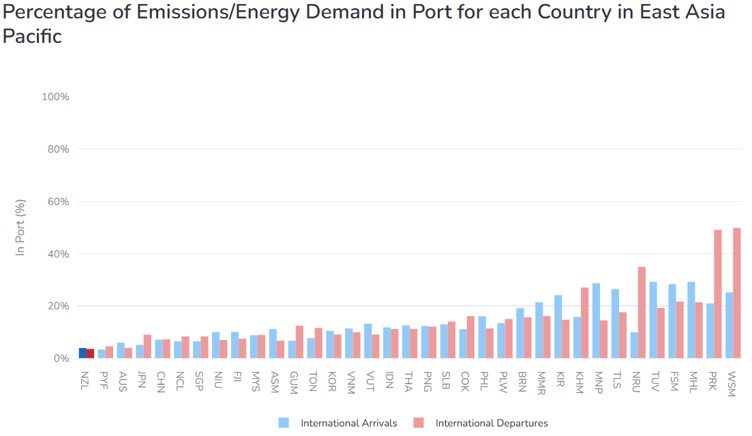
In New Zealand, 3.9% of international arrivals’ shipping emissions and 3.5% of international departures’ shipping emissions are “in port” That’s according to a new emissions assessment tool from UCL. These are the lowest aggregate figures in the region.
Climate funds attracting record private capital
Analysis from the Global Private Capital Association’s Mid-Year 2026 Industry Data & Analysis, tells us climate focused funds attracted US$5.5 billion (NZ$9.4bn) of investment in the first half of 2026, which is more than the total for the whole of 2025 (US$4.2bn, NZ$7.2bn) and more than the annual totals for six of the last eight years.
Away fans’ emissions impact illuminated
Regardless of your favourite sport and quite how low planes fly over stadia, we all might be able to learn a little from new guidelines that might help shed light on how best to assess the emissions of travelling supporters. EUFA, the European soccer association has published the guidelines and incorporated them into its carbon footprint calculator, aimed at informing clubs on the emissions impact of their travelling supporters.
Free cooling
Scientists from the Karlsruher Institute of Technology and the University of Tsukuba have created a heat-driven, elastocaloric cooling system that leverages ambient warmth, waste heat or solar energy to provide cooling without the need for a power source. The technology relies on shape-memory alloy films instead of an electric motor. The system uses two films, one converts heat into mechanical work, the second converts that work into cold without the need for mechanical assistance or refrigerants. Using an 86C input, the prototype system delivered 13C of cooling.
Sunscreen for train tracks
Amid safety concerns for rail travel in extreme heat, the Korea Railroad Research Institute is testing a thermal blocking textile system to keep track temperatures down. While most rail track cooling systems involve spraying water onto the tracks, the new system adheres the textile to the side of the rail using magnets. The textile reflects 85% of solar radiation to keep the tracks up to 10.9C cooler. Crucially, once fixed on, it becomes a zero maintenance solution unlike the water spraying systems.
Did you know …….
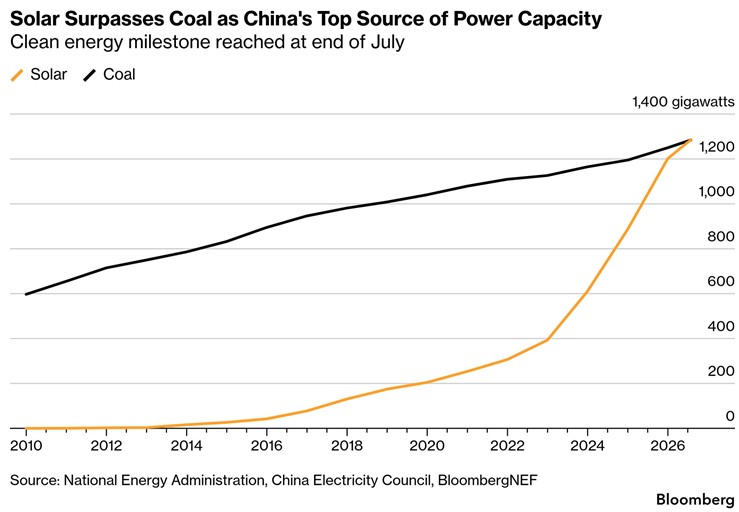
Solar has just superseded coal as China’s leading source of electricity generation capacity?