
Sports under threat, parasols and old is new for heat pumps

In this issue:
Climate change “biggest risk” – long term
The World Economic Forum’s Global Risk Report 2026 lists extreme weather events as the biggest global risk over the long term. Second on the list was risks to nature. Noting this was a ranking exercise, environmental concerns ranked lower in the short term, with extreme weather ranking fourth. Heading the short term risks list was geoeconomic confrontation, followed by misinformation and disinformation (combined category) and social polarisation.
The parasol effect
While climate risks may be seen as the biggest risk over the long term, a new study from the University of Exeter and Faculty of Actuaries indicates we may still be underestimating the magnitude of climate risk. The main underweighted factor according to the report is the loss of aerosol cooling, the cooling effect of air pollutants providing shading, estimated to account for around 0.5C. As pollutants reduce, the shading will reduce and temperatures will lift more quickly. The report suggests warming will reach 2C by 2050.
Embedding climate strategies pays off
A new analysis of corporate returns by CDP indicates embedding climate and nature considerations into business decisions has delivered over US$200billion (NZ$334bn) in opportunities over the last 12 months for leaders in the practice. The analysis indicates this 15% of companies has cut emissions at four times the rate of others, as well as enjoying the opportunities upside. These companies are also enjoying significantly higher market capitalisation, other things being equal (or controlled for).
The potential for AI
We hear plenty about AI, both about its energy appetite and its potential efficiency benefits. A new report from the AI for Decarbonisation Virtual Centre of Excellence (ADViCE), unsurprisingly, focuses on the latter and assigns ratings of potential for decarbonisation to over 90 applications. Examples include assisting the UK grid operator save 300,000 tonnes of emissions, adding 3%-5% to wind farm productivity and a 42% drop in peak demand on EV charging.
Heat pump storage
Neither domestic storage heaters nor heat pumps are new technologies but a Swiss/Norwegian collaboration has combined the two to create an efficient, domestic heating and cooling unit. Salt hydrates are used to store heat generated by the pump when power is cheap, which is then released on demand. The hydrates need only about a quarter of the storage space of water for the same storage capacity.
The repercussions of greenhushing
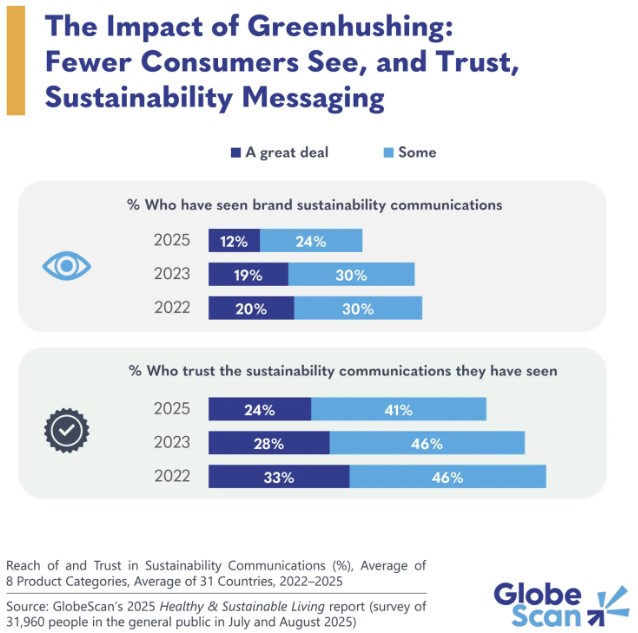
Greenhushing followed greenwashing with many organisations now far less vocal on their activities for fear of being called out for false or exaggerated claims. But greenhushing has its downside too, with Globe Scan reporting sharp declines in the numbers of people seeing sustainability communications and in the trust they have in what those communications say.
Sports industry at risk from climate change
The global sports industry is booming. A World Economic Forum report suggests the sector could expand to US$8.8 trillion (NZ$14.7trn) by 2050, up from the current US$2.3 trillion (NZ$3.8trn). However, a substantial part of this is seen as at risk because of climate change, specifically from disruptions caused by heat stress. We already see extended water breaks in sports like tennis and rugby but as temperatures increase, the severity of disruptions could extend to altering playing seasons and even making certain professional sports unviable in some regions.
Did you know ……
It only took 10 days for the world’s richest 1% to exhaust their carbon budget for the year? The richest 0.1% had exhausted their budgets by 3rd January. Data crunching like this by Oxfam reveals other statistics, such as the UK’s richest 0.1% producing more carbon pollution in 8 days than someone in the bottom 50% emits over an entire year. Globally, the emissions produced by the richest 1% each year are projected to cause around 1.3 million heat-related deaths by the end of the century.